Passing the Topstep Trading Combine is less about finding a better setup and more about not breaking the rules while you trade the setup you already have.
This guide gives you a simple plan: how to size your trades, when to stop each day, and how to review so you don't repeat the same mistake. (New to the rules? Start with Topstep rules explained.)
All Topstep numbers below come from Topstep's Help Center, checked on October 19, 2026. Always confirm the current rules there before you start.
The numbers you're playing against
- $50K: Profit Target $3,000, Max Loss Limit (trailing) $2,000, best day must stay under $1,650.
- $100K: Profit Target $6,000, Max Loss Limit (trailing) $3,000, best day must stay under $3,300.
- $150K: Profit Target $9,000, Max Loss Limit (trailing) $4,500, best day must stay under $4,950.
Two things make the Combine harder than it looks:
- The Maximum Loss Limit trails your end-of-day high. Every green day shrinks the room you have to lose, until it locks at your starting balance.
- The 55% Consistency Target. One huge day doesn't pass you faster. It raises your profit target (best day ÷ 0.55).
So the winning approach is boring on purpose: many small green days, no giant red day.
Step 1: Decide your daily risk before you trade
Pick a daily stop that is a small slice of your Maximum Loss Limit, so one bad day can't end the Combine.
For example, on a $50K account (MLL $2,000), some traders cap a day at $200-$300. That's 10-15% of the MLL. It's a personal rule of thumb, not a Topstep rule, but the idea is simple: you should be able to survive several bad days in a row.
Then work backwards to trade size: if your stop on a trade is 10 points on MES ($5 per point per micro), one micro risks $50, so 2 micros risks $100 per trade.
Want it enforced? Topstep lets you add a Daily Loss Limit at purchase, or a Personal Daily Loss Limit in Risk Settings, which can liquidate and lock you out for the session.
Step 2: Put a ceiling on your good days too
This is the step most traders skip.
On a $50K Combine, your best day has to stay under $1,650. If you're having a great day and you're near that number, stop. Extra profit today doesn't help you pass. It raises your target. Topstep says it directly: you can't fix a too-big day by trading more on the same day, because your best day keeps updating until 3:10 PM CT.
A simple rule: stop for the day at about half your profit target. On TopstepX you can even set a Personal Daily Profit Target that closes your positions for you.
Step 3: Trade one plan, the same way, every day
Write your plan in three lines before the session:
- Setup: the one or two setups you take, and nothing else.
- Hours: when you trade, and when you stop (many traders only trade the first 1-2 hours).
- Exit rules: where the stop goes, and when you move it (only in your favor).
The Combine is a test of consistency. A plan you can repeat every day is worth more than a "perfect" plan you follow twice a week.
Step 4: Know your danger moments
Most blown Combines come from the same few moments:
- Right after a loss. The urge to win it back fast, with more size. That's revenge trading.
- After missing a move. Jumping in late and chasing. That's FOMO trading.
- Close to the MLL. Holding a loser "until it comes back", while unrealized P&L counts against you in real time.
- On a great day. Not stopping, and breaking the 55% line.
Write these down. When you notice one, step away from the screen for 10 minutes.
Step 5: Review every day, in 10 minutes
At the end of the day, answer three questions:
- Did I follow my plan on every trade? Mark each trade A (followed, won), B (followed, lost) or C (broke the plan).
- For every C trade: what exactly did I do? ("Moved my stop", "entered before the candle closed", "added size after a loss".)
- What is the one thing I'll do differently tomorrow?
B trades are fine. Losing trades are part of the plan. C trades are what fail Combines. (More on this in how to keep a trading journal.)
Make the review faster: watch the trade back
The hardest part of step 5 is remembering what you actually did. Your memory of a trade is usually cleaner than the trade.
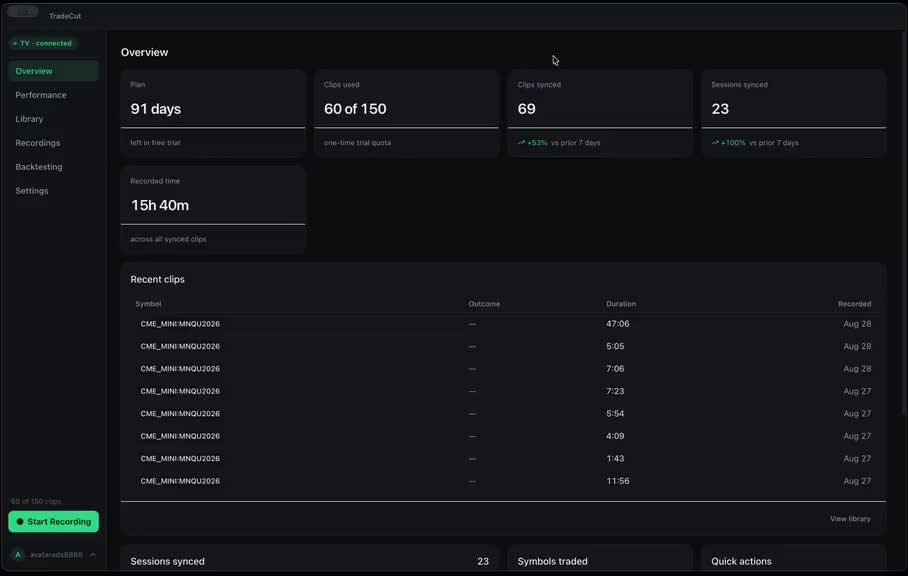
TradeCut records your trading screen in the background and saves one short clip per trade, from entry to exit, with the symbol, side, time and result. On TradingView it detects your trades by itself, and NinjaTrader 8 works through an add-on. So your daily review becomes: open today in the calendar, click the C trades, and watch the exact moment you broke the plan.
A sample week on a $50K Combine (example only)
- Mon: +$450. Stopped after 2 winners.
- Tue: -$250. Hit daily stop. Done for the day.
- Wed: +$700. Stopped at the "half target" ceiling.
- Thu: +$600.
- Fri: +$500.
Total: +$2,000. Best day $700 = 35% of total. The trader is on track, and no single day put the Combine at risk. (This is an illustration of the plan, not a real account or a promise of results.)
FAQ
How long does it take to pass the Topstep Combine?
There's no fixed time. You need at least 2 trading days, and no day can be more than 55% of your total profit. Most traders take longer, because they spread the target over many small days.
What's the most common reason traders fail the Combine?
Topstep says over 63% of traders have lost an account in a single day. That's why a daily loss limit, and stopping after a bad trade, matter more than any setup.
Can I trade the news in the Combine?
Check Topstep's permitted products, trading hours and prohibited strategies pages before you do. Those rules change, and we don't want to give you an outdated answer.
What happens if I fail?
In the Combine, breaking the Maximum Loss Limit makes the account ineligible until you Reset. Check Topstep's Reset page for the current options.
TradeCut is not affiliated with Topstep. Rules checked on Topstep's Help Center on October 19, 2026; always confirm the current rules there.
Related posts
- Topstep Rules Explained (2026): Max Loss, Consistency Target and Daily Loss LimitTopstep's Trading Combine rules in plain English: the trailing Maximum Loss Limit, the 55% Consistency Target, the Daily Loss Limit and position size, with examples.
- FOMO Trading: Why You Chase Trades and How to StopWhat FOMO trading is, the signs you're chasing, why it costs you money, and 7 simple rules to stop jumping into moves you already missed.